Nonblocking TLM port and Imp Port
Table of Contents
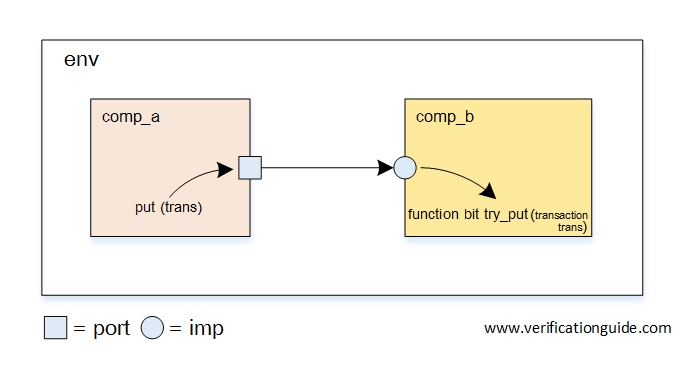
This example shows how to declare, create and connect the TLM non-blocking ports, implementing and using the TLM non-blocking methods. In this example blocking ports of the previous example (Connecting TLM Port and Imp Port) are replaced with the non-blocking ports. It is preferred to refer to Connecting TLM Port and Imp Port example before going through this example.
Below are the steps to implement a TLM Communication mechanism between comp_a and comp_b.
- Declare and Create TLM Port in comp_a
- Declare and Create TLM Imp Port in comp_b
- Connect TLM Port and Imp Port in env
- Call interface method in comp_a to send the transaction
- Implement interface methods in comp_b to receive the transaction
TLM TesetBench Components are,
———————————————————-
Name Type
———————————————————-
uvm_test_top basic_test
env environment
comp_a component_a
trans_out uvm_nonblocking_put_port
comp_b component_b
trans_in uvm_nonblocking_put_imp
———————————————————-
Declare and Create TLM Port in comp_a
class component_a extends uvm_component; //Step-1. Declaring Non-blocking port uvm_nonblocking_put_port #(transaction) trans_out; `uvm_component_utils(component_a) //--------------------------------------- // Constructor //--------------------------------------- function new(string name, uvm_component parent); super.new(name, parent); trans_out = new("trans_out", this); //Step-2. Creating the port endfunction : new //--------------------------------------- // run_phase //--------------------------------------- virtual task run_phase(uvm_phase phase); endtask : run_phaseendclass : component_a |
Declare and Create TLM Port in comp_b
class component_b extends uvm_component; transaction trans; //Step-1. Declaring nonblocking put imp port uvm_nonblocking_put_imp #(transaction,component_b) trans_in; `uvm_component_utils(component_b) //--------------------------------------- // Constructor //--------------------------------------- function new(string name, uvm_component parent); super.new(name, parent); trans_in = new("trans_in", this); //Step-2. Creating the port endfunction : newendclass : component_b |
Connect TLM Port and Imp Port in env
function void connect_phase(uvm_phase phase); //Step-1, Connecting the ports comp_a.trans_out.connect(comp_b.trans_in);endfunction : connect_phase |
Call interface method in comp_a to send the transaction
As the port declared is a nonblocking port, the try_put method has to be used for sending the transaction packet.
void'(trans.randomize());trans_out.try_put(trans); |
Implement an interface method in comp_b to receive the transaction
1. In order to receive the transaction on nonblocking imp port try_put and can_put methods has to be implemented.
Note:
As the port is nonblocking, methods should be implemented as function not task.
In the blocking example, the put method is implemented as a task.
virtual function try_put(transaction trans); `uvm_info(get_type_name(),$sformatf(" Inside try_put method"),UVM_LOW) `uvm_info(get_type_name(),$sformatf(" Recived trans On IMP Port"),UVM_LOW) `uvm_info(get_type_name(),$sformatf(" Printing trans, \n %s",trans.sprint()),UVM_LOW)endfunction |
virtual function bit can_put();endfunction |
* Implementing and using of can_put is shown in the next example
2. Complete comp_b code
class component_b extends uvm_component; transaction trans; uvm_nonblocking_put_imp#(transaction,component_b) trans_in; `uvm_component_utils(component_b) //--------------------------------------- // Constructor //--------------------------------------- function new(string name, uvm_component parent); super.new(name, parent); trans_in = new("trans_in", this); endfunction : new //--------------------------------------- // Imp port try_put method //--------------------------------------- virtual function bit try_put(transaction trans); `uvm_info(get_type_name(),$sformatf(" Inside try_put method"),UVM_LOW) `uvm_info(get_type_name(),$sformatf(" Recived trans On IMP Port"),UVM_LOW) `uvm_info(get_type_name(),$sformatf(" Printing trans, \n %s",trans.sprint()),UVM_LOW) endfunction //--------------------------------------- // Imp port can_put method //--------------------------------------- virtual function bit can_put(); endfunctionendclass : component_b |
Simulator Output
UVM_INFO @ 0: reporter [RNTST] Running test basic_test...
------------------------------------------------------
Name Type Size Value
------------------------------------------------------
uvm_test_top basic_test - @1839
 env environment - @1908
 comp_a component_a - @1940
 trans_out uvm_nonblocking_put_port - @1975
 comp_b component_b - @2008
 trans_in uvm_nonblocking_put_imp - @2043
------------------------------------------------------
UVM_INFO component_a.sv(29) @ 0: uvm_test_top.env.comp_a [component_a] tranaction randomized
UVM_INFO component_a.sv(30) @ 0: uvm_test_top.env.comp_a [component_a] Printing trans,
 ---------------------------------
Name Type Size Value
---------------------------------
trans transaction - @1135
 addr integral 4 'he
 wr_rd integral 1 'h0
 wdata integral 8 'h4
---------------------------------

UVM_INFO component_a.sv(32) @ 0: uvm_test_top.env.comp_a [component_a] Before calling port put method
UVM_INFO component_b.sv(24) @ 0: uvm_test_top.env.comp_b [component_b] Inside try_put method
UVM_INFO component_b.sv(25) @ 0: uvm_test_top.env.comp_b [component_b] Recived trans On IMP Port
UVM_INFO component_b.sv(26) @ 0: uvm_test_top.env.comp_b [component_b] Printing trans,
 ---------------------------------
Name Type Size Value
---------------------------------
trans transaction - @1135
 addr integral 4 'he
 wr_rd integral 1 'h0
 wdata integral 8 'h4
---------------------------------

UVM_INFO component_a.sv(34) @ 0: uvm_test_top.env.comp_a [component_a] After calling port put method
UVM_INFO /playground_lib/uvm-1.2/src/base/uvm_objection.svh(1271) @ 0: reporter [TEST_DONE]
UVM_INFO /playground_lib/uvm-1.2/src/base/uvm_report_server.svh(847) @ 0: reporter [UVM/REPORT/SERVER]

The next example shows the implementation of the can_put() method.
❮ Previous Next ❯